As far as artist statements go, the best I can do is this.
I record and react to what I find as I spend my days turning over rocks in the primordial tide pools of geometry.
That sorted, let’s see what we’ve got.
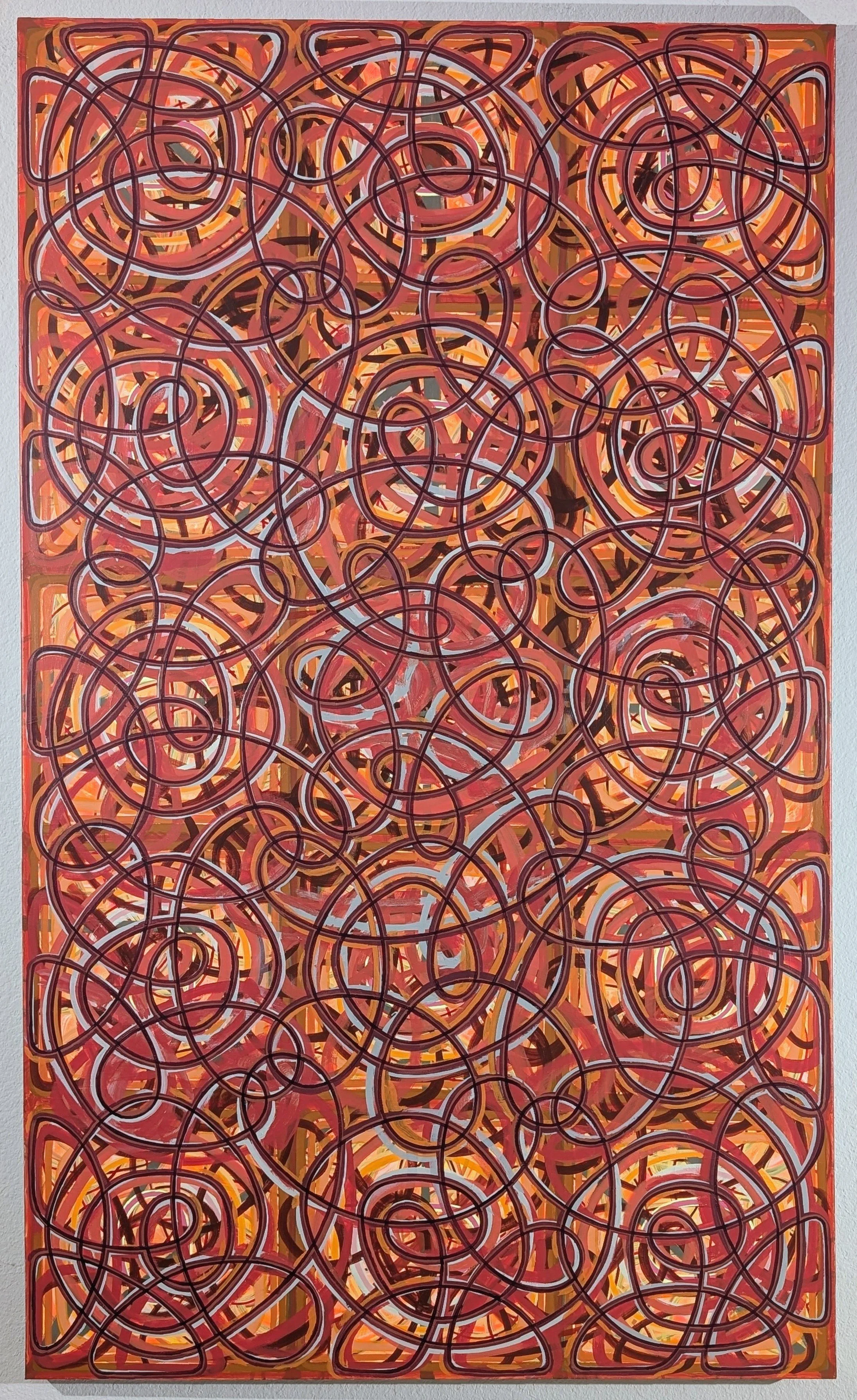
Confound your regular practice 20261119 60×36” acrylic on canvas $1597
Continuing with the exploration of how the figure reckons with the rectangle it inhabits, this one distributes the figure’s modular components within a three by five grid. The best way to preserve symmetry while doing so involved traversing the tiles in something akin to a hilbert curve, with a weird handshake in the middle. Very fun problem solving to eye-popping gyroscopic effect.
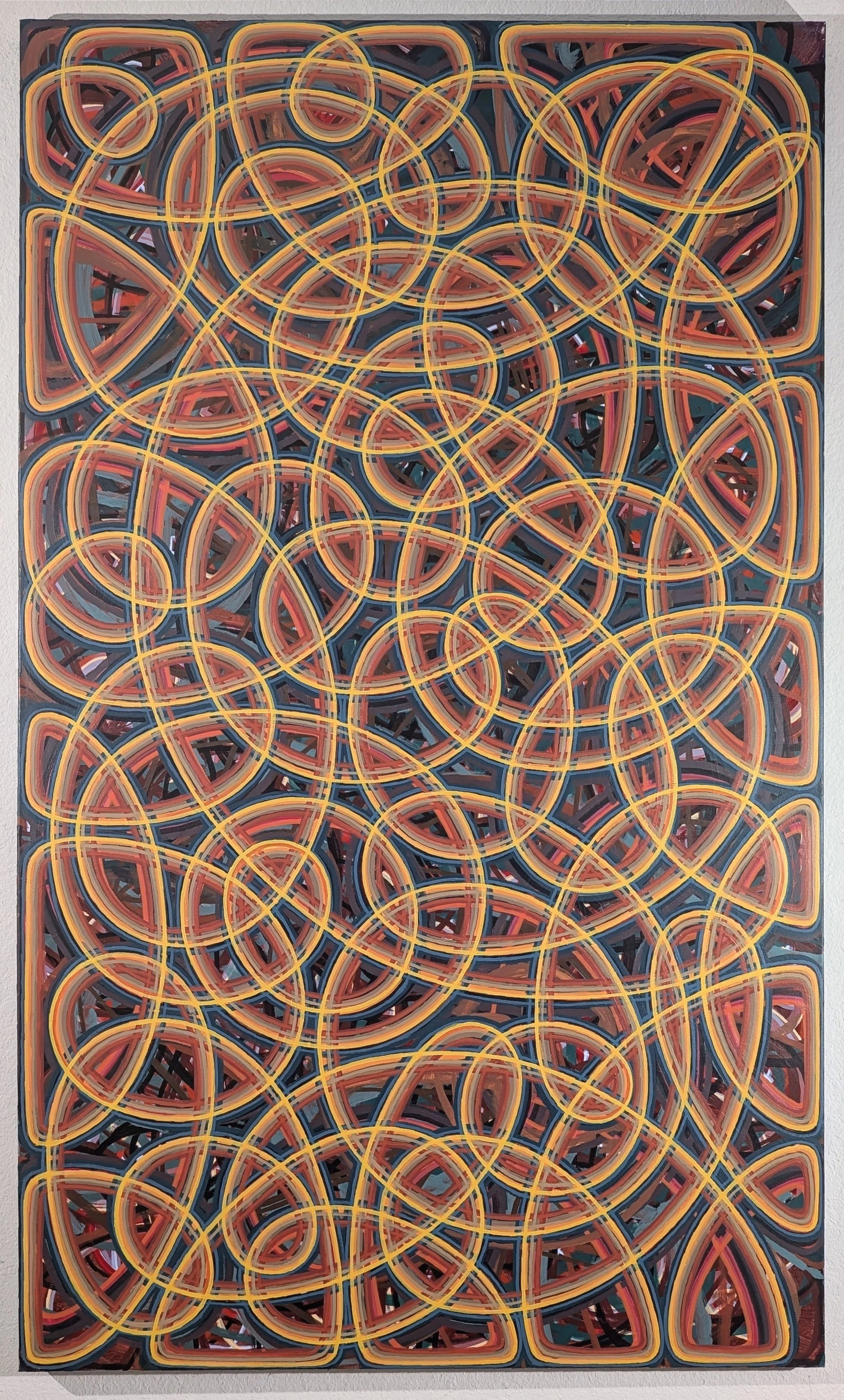
Conceive some new lore 20261111 60×36” acrylic on canvas $1597
Looking at a painting and looking through a painting are different. I find myself much occupied with the latter of late. The whole thing is one continuous figure, but all of the little alcoves are each their own thing, and an observer can peer into them and see evidence of how they got to their current state. The conversations between the colors, the gradient trajectories that function like time intervals, are becoming more important. What we experience is the top crust of more than 13 billion years of stuff happening. Sometimes we can get a glimpse of the trajectory through the crevices.
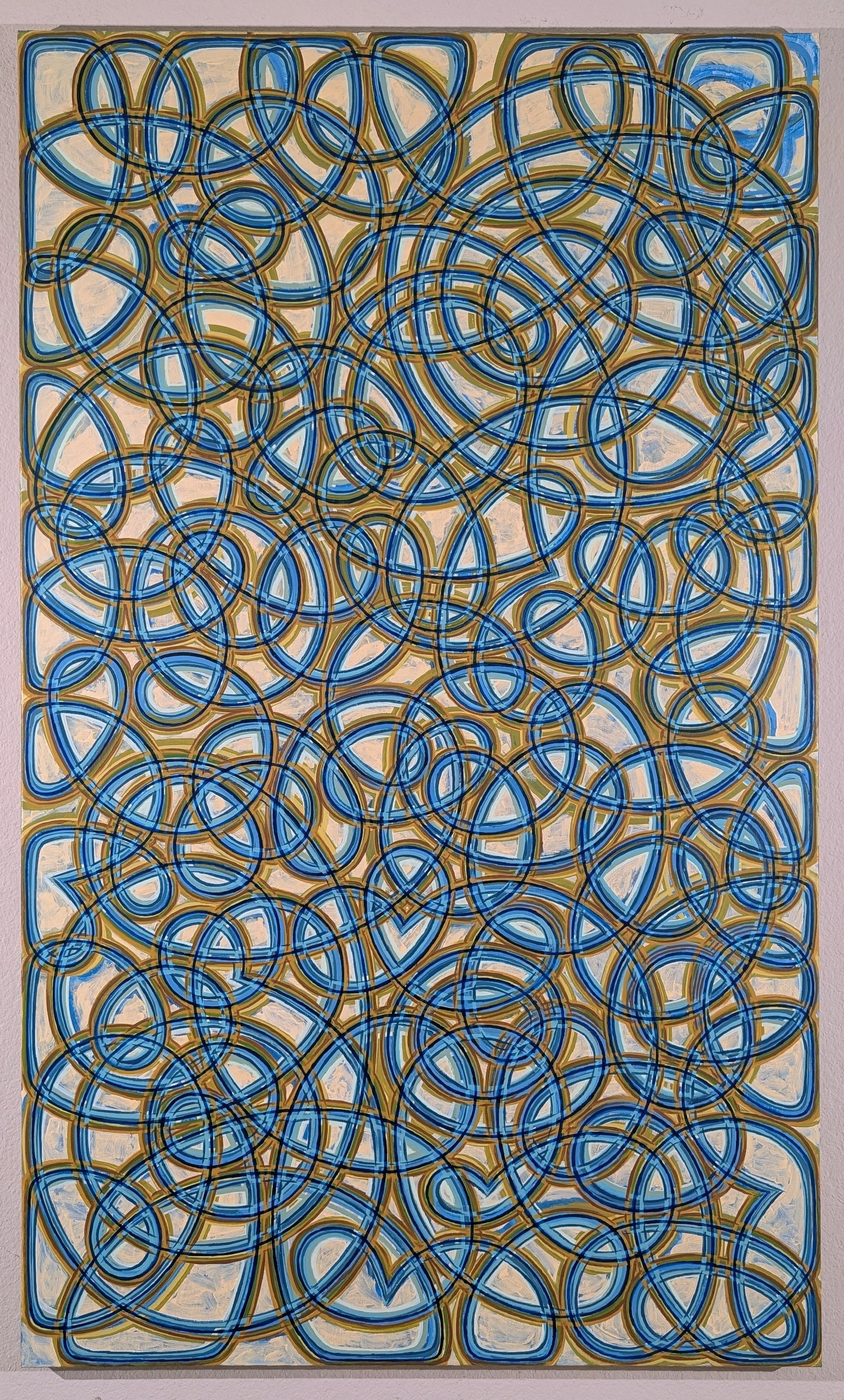
Stop becoming what you don’t want to be 20261029 60×36” acrylic on canvas $1597
A friend said it is pushing up against the sides like dough rising in a bread pan. There’s also a strong backlit stained glass sensibility. Crystalline, delicate, transparent to the suggestion of early twilight. Light, or more specifically the way humans comprehend its interactions with the material, is arguably the only thing any painting concerns itself with.
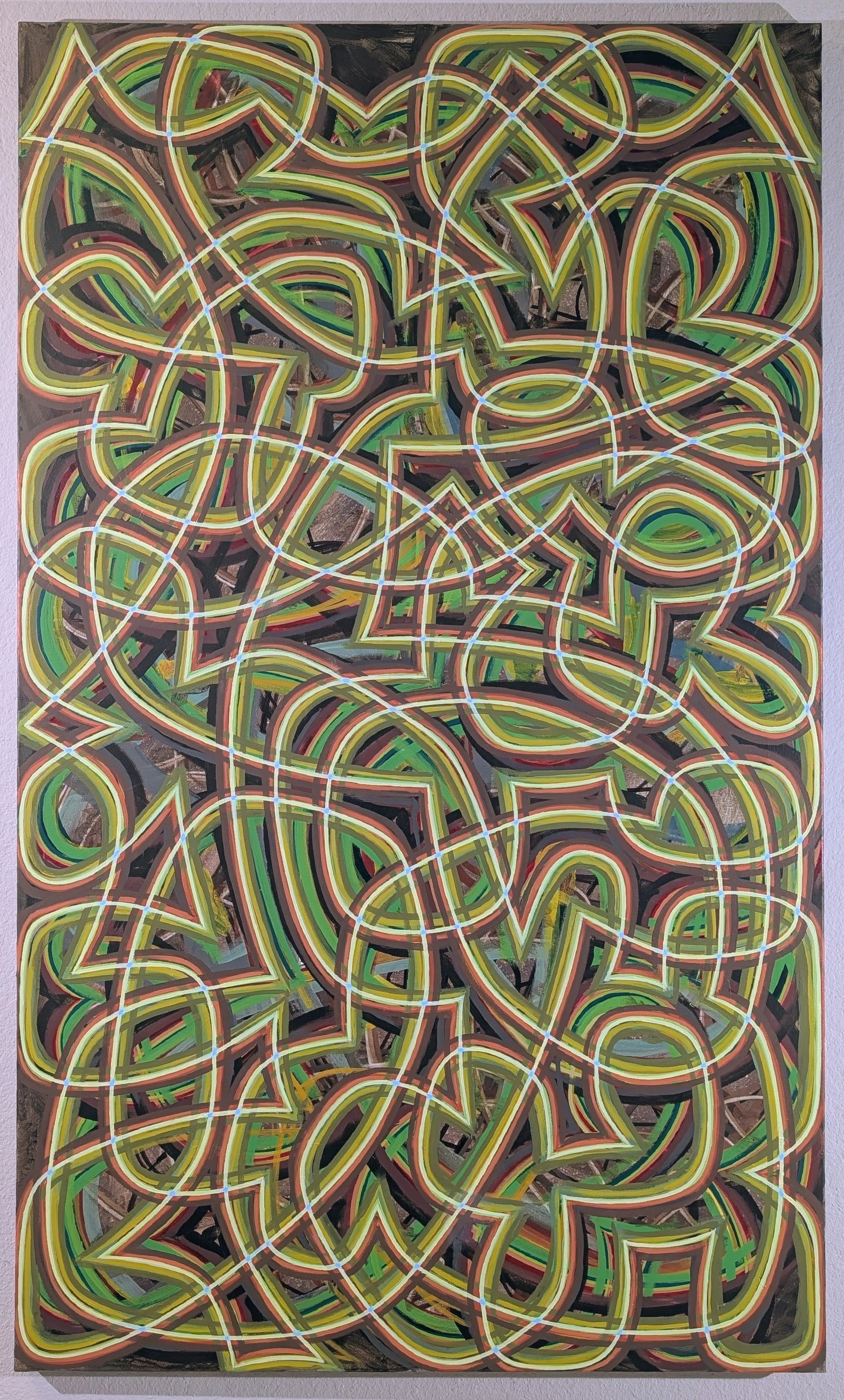
Internalize the externalities 20261012 60×36” acrylic on canvas $1597
We’re past the point now where the circle immersion figures have developed an awareness about the rectangle and actively engage with it. I’ve tried having loops pass beyond the edge of the rectangle, with the thought that this might foster engagement by allowing the observer to complete the figure mentally, but something essential is lost. Instead of being an object that inhabits the same space with the observer, the painting becomes a cropped picture of something happening in a separate place and time. That let’s all the air out. This, in contrast, pushes its face right up against the glass.
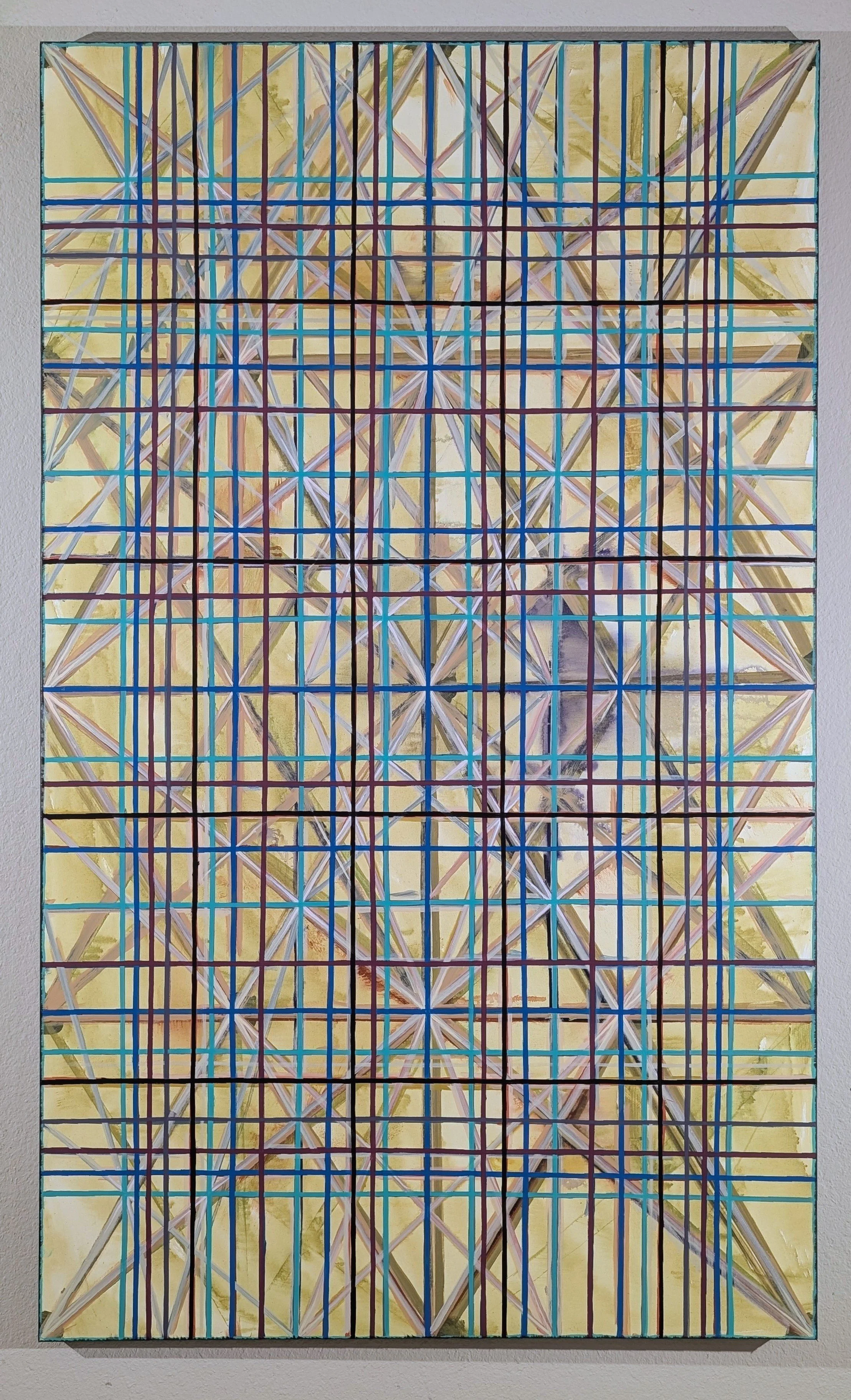
Count down from nine 20260927 60×36” acrylic on canvas $1597
Turns out that, starting from nothing but the relationship between the four corners of a rectangle, without any tools or measurements beyond the ability to create parallel lines, it is possible to accurately divide it into halves, thirds, fifths, sevenths, and all the powers thereof. I suspect that, given fine enough resolution, this could conceivably extend to all prime denominators, meaning that the specific locations for all of the infinite points within the plane of the rectangle are stored within the relationship between the four points at its corners. That's some black hole level data compression right there.
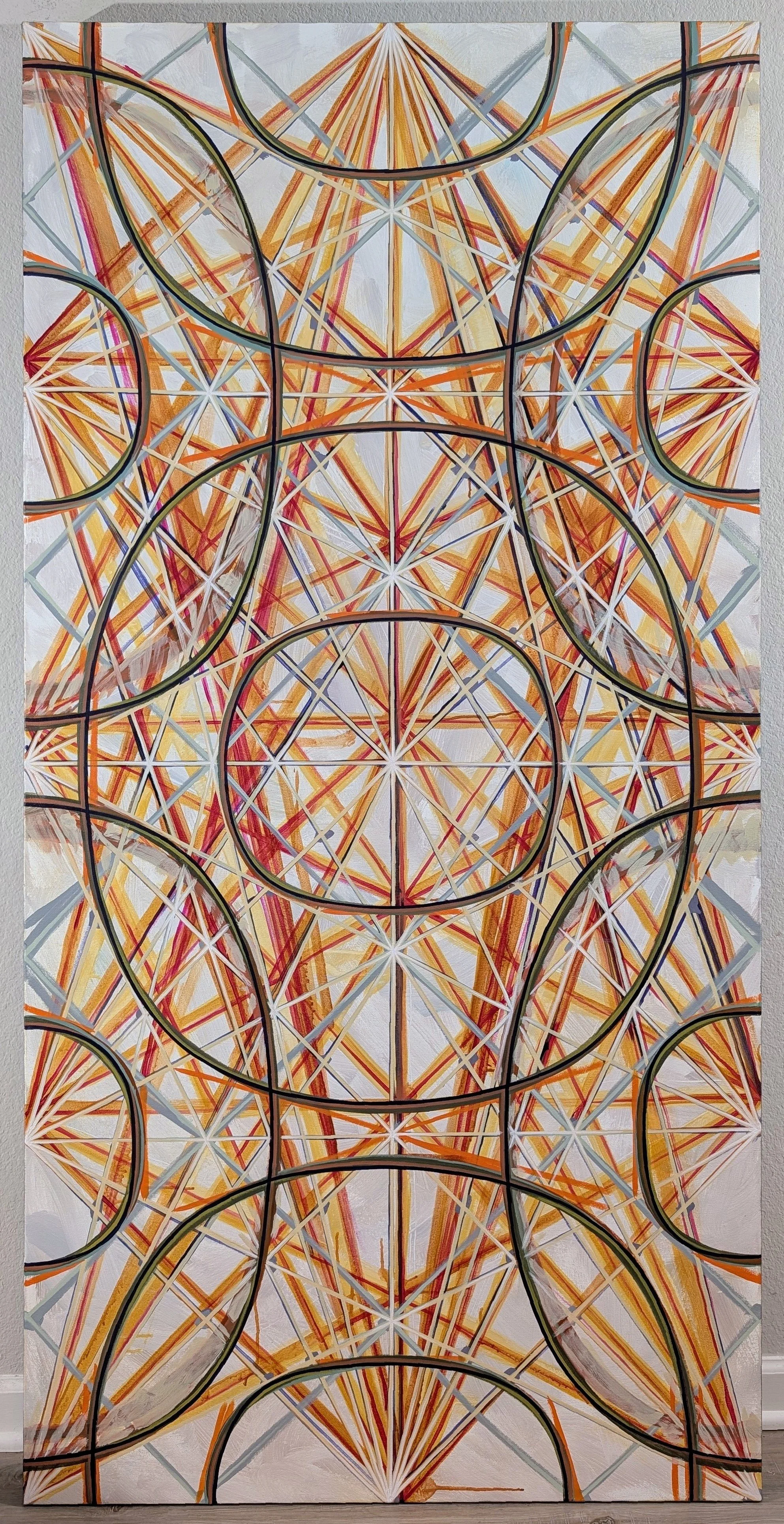
Start starting over over 20260921 72×36” acrylic on canvas $2594
Every painting is a fresh start, but not from scratch. It exists on a continuum of ideas emerging from an evolving visual grammar that it materially extends. That doesn’t mean the paintings get progressively better, because making one isn’t an attempt to do the same thing again only better. Each one, even in a series, is an exploration of new territory. If it isn’t, I keep working on it until that’s true. If I haven’t learned something new, if there isn’t something surprising I haven't already seen previously, we’re not done.

Interrogate the substrate 20260908 36×72” acrylic on canvas (private collection)
This ended up just being an exercise wherein a rectangle twice as wide as tall described itself to me, and I took attentive notes. It had a lot to say. Being reductive and being subtractive are profoundly different perceptual strategies.
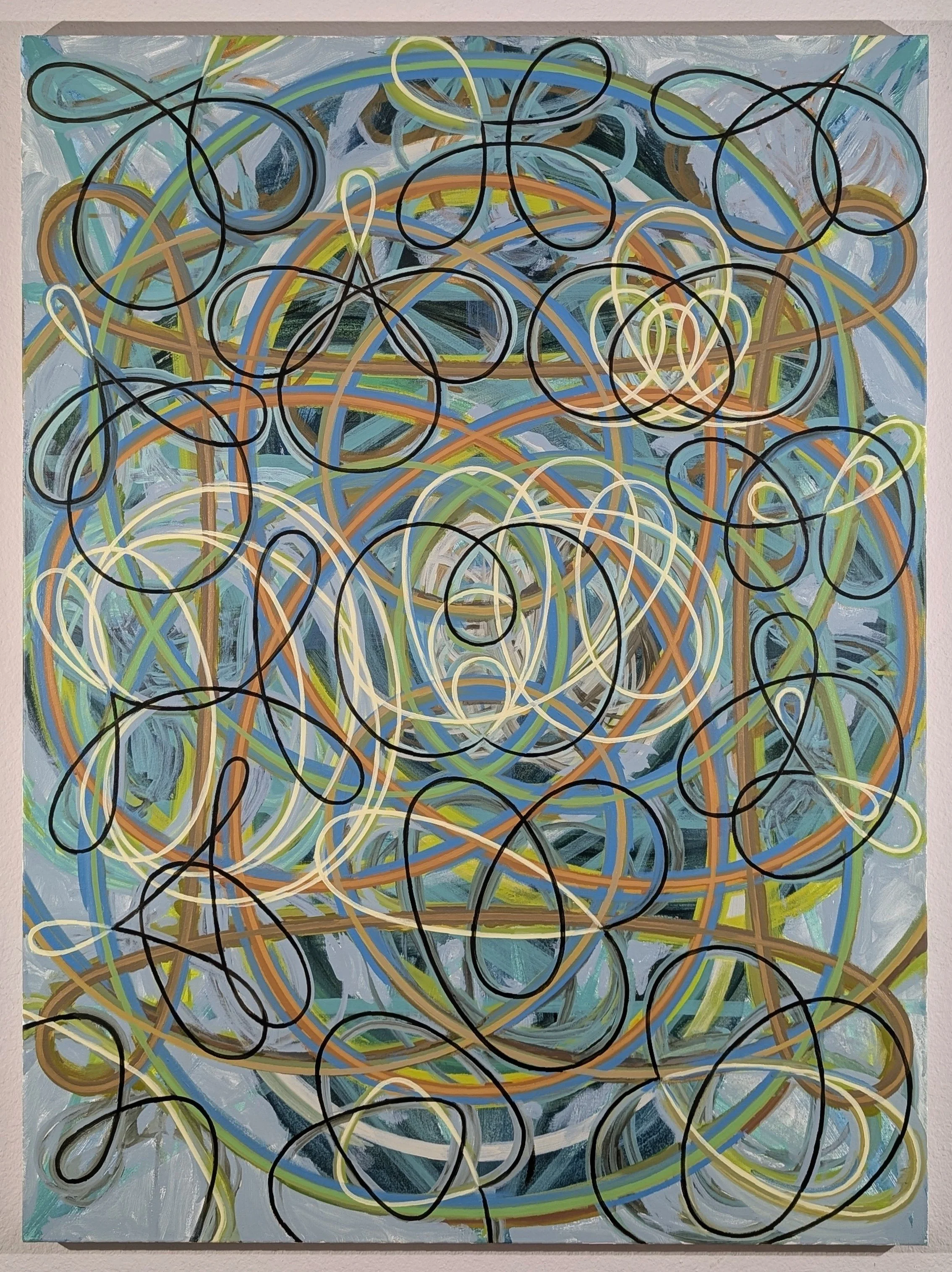
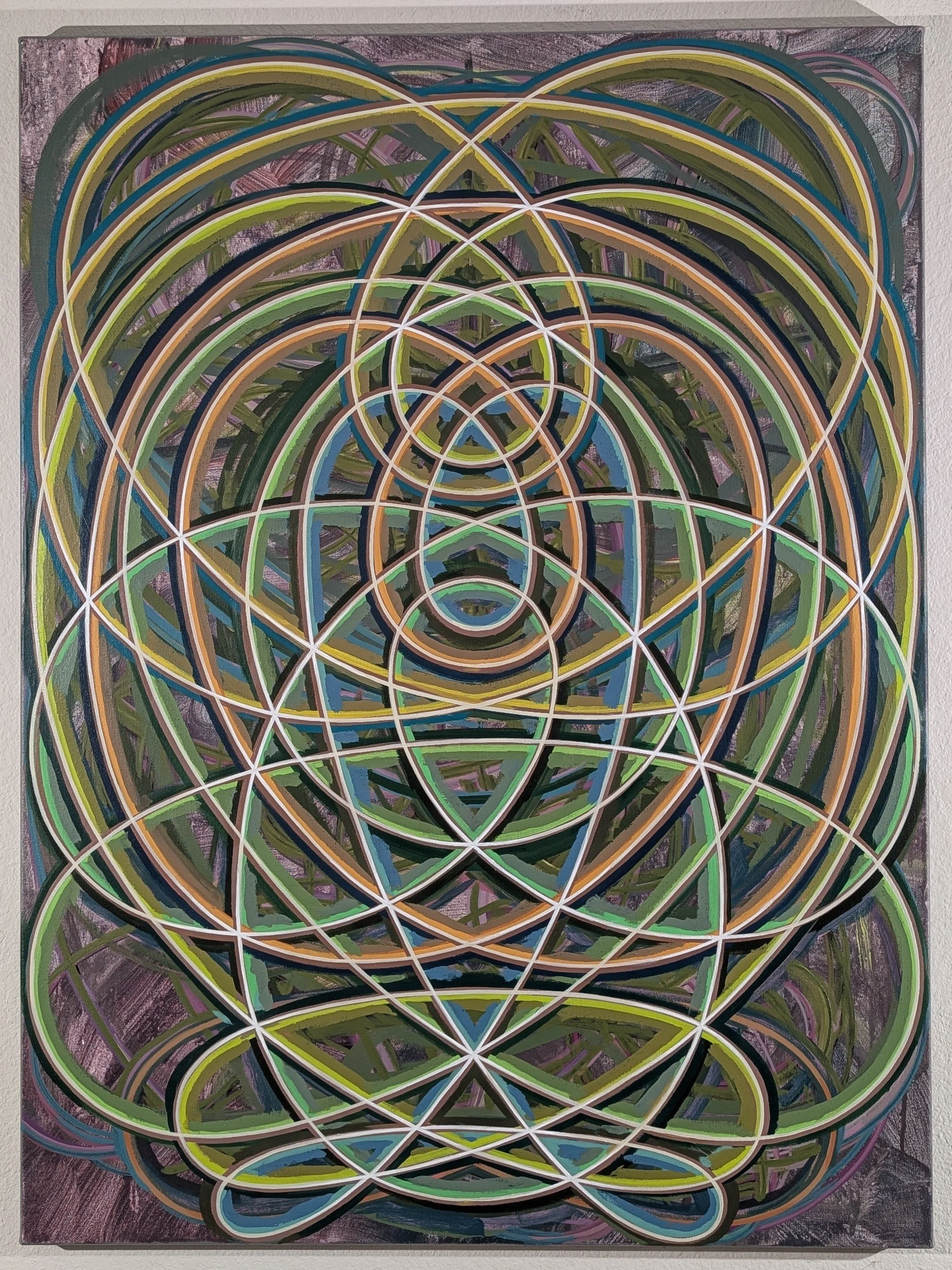
Welcome the flies 20260801 36×48” acrylic on canvas $987 (above)
Pay more attention to less 20260801 36×48” acrylic on canvas $987 (below)
These two are divergent siblings, in that their color profiles and basic concepts are shared, but also in that the treatment of those concepts reflects opposite ends of the spectrum between the liturgical and the lyrical, poles between which a caravan conveying our capacities for focused attention, appreciation, and wonder migrates.
I suspect most will have a strong preference for one or the other.